Anime and Its Roots in Early Japanese Monster Art
The history of anime can be traced back to the offset of the 20th century, with the earliest verifiable films dating from 1907.[1] Before the advent of film, Japan already had a rich tradition of entertainment with colourful painted figures moving across the projection screen in utsushi-east ( 写し絵 ), a detail Japanese type of magic lantern show pop in the 19th century. Possibly inspired by European phantasmagoria shows, utsushi-e showmen used mechanical slides and developed lightweight wooden projectors (furo) that were handheld then that several performers could each control the motions of unlike projected figures.[ii] [3]
The second generation of animators in the late 1910s included Ōten Shimokawa, Jun'ichi Kōuchi and Seitaro Kitayama, normally referred to as the "fathers" of anime.[4] Propaganda films, such as Momotarō no Umiwashi (1943) and Momotarō: Umi no Shinpei (1945), the latter beingness the showtime anime feature film, were made during Earth War II. During the 1970s, anime developed further, with the inspiration of Disney animators, separating itself from its Western roots, and developing distinct genres such as mecha and its super robot subgenre. Typical shows from this catamenia include Astro Boy, Lupin III and Mazinger Z. During this menses several filmmakers became famous, specially Hayao Miyazaki and Mamoru Oshii.
In the 1980s, anime became mainstream in Japan, experiencing a blast in production with the ascension in popularity of anime like Gundam, Macross, Dragon Ball, and genres such equally real robot, space opera and cyberpunk. Space Battleship Yamato and The Super Dimension Fortress Macross also achieved worldwide success later being adapted respectively as Star Blazers and Robotech.
The film Akira set records in 1988 for the production costs of an anime motion picture and went on to become an international success. After, in 2004, the same creators produced Steamboy, which took over every bit the most expensive anime film. Spirited Away shared the first prize at the 2002 Berlin Pic Festival and won the 2003 Academy Honour for Best Animated Feature, while Innocence: Ghost in the Shell was featured at the 2004 Cannes Film Festival.
Precursors [edit]
Before picture, Japan had already several forms of entertainment based in storytelling and images. Emakimono and kagee are considered precursors of Japanese animation. Emakimono was common in the eleventh century.[5] Traveling storytellers narrated legends and anecdotes while the emakimono was unrolled from the right to left with chronological order, every bit a moving panorama.[5] Kagee was popular during the Edo period and originated from the shadows play of People's republic of china.[5] Magic lanterns from kingdom of the netherlands were also popular in the eighteenth century.[5] The paper play called Kamishibai surged in the twelfth century and remained popular in the street theater until the 1930s.[5] Puppets of the bunraku theater and ukiyo-eastward prints are considered ancestors of characters of most Japanese animations.[5] Finally, manga were a heavy inspiration for Japanese animation. Cartoonists Kitzawa Rakuten and Okamoto Ippei used film elements in their strips in the early on 20th century.[v]
Origins of anime (early 1900s – 1922) [edit]
According to Natsuki Matsumoto, the first animated film produced in Japan may accept stemmed from as early every bit 1907. Known every bit Katsudō Shashin ( 活動写真 , "Activity Photo"), from its depiction of a boy in a sailor suit drawing the characters for katsudō shashin, the moving picture was first establish in 2005. It consists of fifty frames stencilled direct onto a strip of celluloid.[6] [7] This claim has not been verified though and predates the first known showing of animated films in Japan. The date and offset film publicly displayed is another source of contention: while no Japanese-produced animation is definitively known to appointment before 1916, the possibility exists that other films entered Japan and that no known records have surfaced to prove a showing prior to 1912.[i] Movie titles have surfaced over the years, but none accept been proven to predate this year. The offset foreign animation is known to accept been found in Japan in 1910, merely it is not clear if the film was e'er shown in a movie theater or publicly displayed at all. Yasushi Watanabe found a film known every bit Fushigi no Bōrudo ( 不思議のボールド , "Miracle Board") in the records of the Yoshizawa Shōten ( 吉沢商店 ) visitor. The clarification matches James Blackton's Humorous Phases of Funny Faces, though academic consensus on whether or non this is a truthful animated motion-picture show is disputed.[1] According to Kyokko Yoshiyama, the showtime animated picture chosen Nippāru no Henkei ( ニッパールの変形 , "Nippāru'south Transformation") was shown in Japan at the Asakusa Teikokukan ( 浅草帝国館 ) in Tokyo sometime in 1912. Yet, Yoshiyama did non refer to the flick as "blitheness." The get-go confirmed animated flick shown in Nihon was Les Exploits de Feu Follet past Émile Cohl on May 15, 1912. While speculation and other "fox films" have been found in Japan, it is the first recorded account of a public showing of a two-dimensional animated film in Japanese picture palace. During this fourth dimension, German animations marketed for home release were distributed in Japan.[1] In 1914, U.Due south. and European cartoons were introduced to Japan,[8] inspiring Japanese creators like Junichi Kouchi and Seitaro Kitayama,[9] both of whom were considered the "fathers of anime."
Namakura Gatana or Hanawa Hekonai meitō no maki, a brusk Japanese blithe film produced by Jun'ichi Kōuchi in 1917
Few complete animations fabricated during the beginnings of Japanese blitheness have survived. The reasons vary, merely many are of commercial nature. After the clips had been run, reels (being property of the cinemas) were sold to smaller cinemas in the country and and so disassembled and sold as strips or single frames. The beginning anime that was produced in Nippon, Namakura Gatana (Blunt Sword), was made sometime in 1917, only there it is disputed which title was the showtime to become that honour. It has been confirmed that Dekobō Shingachō: Meian no Shippai ( 凸坊新画帳・名案の失敗 , "Bumpy New Picture Volume: Failure of a Slap-up Plan") was made old during Feb 1917. At to the lowest degree two unconfirmed titles were reported to have been made the previous month.[ane]
The first anime short-films were made by 3 leading figures in the industry. Ōten Shimokawa was a political caricaturist and cartoonist who worked for the magazine Tokyo Puck. He was hired past Tenkatsu to do an animation for them. Due to medical reasons, he was only able to do five movies, including Imokawa Mukuzo Genkanban no Maki (1917), before he returned to his previous piece of work as a cartoonist. Another prominent animator in this period was Jun'ichi Kōuchi. He was a caricaturist and painter, who too had studied watercolour painting. In 1912, he also entered the cartoonist sector and was hired for an animation past Kobayashi Shokai later in 1916. He is viewed as the most technically advanced Japanese animator of the 1910s. His works include effectually 15 movies. The 3rd was Seitaro Kitayama, an early on animator who made animations on his ain and was not hired by larger corporations. He eventually founded his own animation studio, the Kitayama Eiga Seisakujo, which was afterward closed due to lack of commercial success. He utilized the chalkboard technique, and afterward paper animation, with and without pre-printed backgrounds. All the same, the works of these pioneers were destroyed after the Groovy Kanto Earthquake of 1923.[five] The works of these two latter pioneers include Namakura Gatana ("An Obtuse Sword", 1917) and a 1918 film Urashima Tarō which were believed to take been discovered together at an antique market in 2007.[ten] However, this Urashima Tarō was later on proved to nigh likely exist a different film of the aforementioned story than the 1918 i by Kitayama, which, as of October 2017, remains undiscovered.[11]
Pre-war productions (1923–1939) [edit]
Yasuji Murata, Hakuzan Kimura, Sanae Yamamoto and Noburō Ōfuji were students of Kitayama Seitaro and worked at his moving-picture show studio. Kenzō Masaoka, another important animator, worked at a smaller blitheness studio. Many early on animated Japanese films were lost afterward the 1923 Tokyo earthquake, including destroying virtually of the Kitayama studio, with artists trying to incorporate traditional motifs and stories into a new course.[12]
Prewar animators faced several difficulties. Starting time, they had to compete with foreign producers such as Disney, which were influential on both audiences and producers.[13] Foreign films had already made a profit away, and could be undersold in the Japanese market, priced lower than what domestic producers needed to pause even.[fourteen] [15] Japanese animators thus had to work cheaply, in small companies with only a handful of employees, which and so made it difficult to compete in terms of quality with foreign product that was in color, with audio, and promoted past much bigger companies. Until the mid-1930s, Japanese animation by and large used cutout animation instead of cel blitheness because the celluloid was besides expensive.[xvi] This resulted in animation that could seem derivative, flat (since motion forward and backward was hard) and without item.[17] But merely as postwar Japanese animators were able to turn limited blitheness into a plus, so masters such every bit Yasuji Murata and Noburō Ōfuji were able to perform wonders that they made with cutout blitheness.
Animators such as Kenzo Masaoka and Mitsuyo Seo, however, did attempt to bring Japanese animation up to the level of foreign piece of work by introducing cel blitheness, sound, and technology such as the multiplane camera. Masaoka created the commencement talkie anime, Chikara to Onna no Yo no Naka, released in 1933,[eighteen] [nineteen] and the first anime made entirely using cel animation, The Dance of the Chagamas (1934).[20] Seo was the starting time to utilise the multiplane camera in Ari-chan in 1941.
Such innovations, notwithstanding, were hard to support purely commercially, so prewar blitheness depended considerably on sponsorship, as animators often concentrated on making PR films for companies, educational films for the government, and eventually works of propaganda for the military.[21] During this time, censorship and schoolhouse regulations discouraged motion picture-viewing by children, then anime that could possess educational value was supported and encouraged by the Monbusho (the Ministry of Educational activity). This proved of import for producers that had experienced obstacles releasing their work in regular theatres. Animation had plant a identify in scholastic, political, and industrial use.
During the second World War [edit]
In the 1930s, the Japanese government began enforcing cultural nationalism. This also lead to strict censorship and control of published media. Many animators were urged to produce animations that enforced the Japanese spirit and national affiliation. Some movies were shown in newsreel theatres, especially after the Film Police force of 1939 promoted documentary and other educational films. Such support helped boost the industry, every bit bigger companies formed through mergers and prompted major live-action studios such as Shochiku to begin producing animation.[22] It was at Shochiku that such masterworks as Kenzō Masaoka's Kumo to Chūrippu were produced. Wartime reorganization of the manufacture, nonetheless, merged the feature moving picture studios into three big companies.
During the Second World War, more animated films were commissioned by the Majestic Japanese Army,[23] [24] showing the sly, quick Japanese people winning against enemy forces. This included films such as Maysuyo Seo's Momotarō: Umi no Shinpei or Momotarō'south Divine Sea Warriors which focused on Japanese occupation of Asia.[25]
Postwar surroundings [edit]
In the post-war years, Japanese media was ofttimes influenced by the U.s.,[9] leading some to define anime as whatsoever animation emanating from Japan after 1945.[26] : 5 While anime and manga began to flourish in the 1940s and 1950s, with foreign films (and layouts by American cartoonists),[27] influencing people such equally Osamu Tezuka,[28]
In the 1950s, anime studios began actualization across Japan. Hiroshi Takahata bought a studio named Nippon Blithe Films in 1948, renaming information technology Tōei Dōga,[15] with an ambition to become "the Disney of the E." While there, Takahata met other animators[29] such equally Yasuji Mori, who directed Doodling Kitty, in May 1957. However, for the Japanese public, it wasn't until the release of Panda and the Magic Serpent in October 1958 that Nippon fully entered into globe of professional animation.[13] While animators began to experiment with their own styles, using Western techniques,[24] Tezuka Osamu began cartoon shonen manga[xxx] like Rob no Kishi (Knight of the Ribbon), which subsequently became Princess Knight, trying to appeal to female readers, while also pioneering shoujo manga.
Toei Animation and Mushi Production [edit]
Toei Animation and Mushi Production was founded and produced the first color anime characteristic moving-picture show in 1958, Hakujaden (The Tale of the White Serpent, 1958). It was released in the US in 1961 as well as Panda and the Magic Serpent.[31] Subsequently the success of the project, Toei released a new feature-length blitheness annually.[32] : 101
Toei's style was characterized by an emphasis on each animator bringing his own ideas to the production. The most extreme example of this is Isao Takahata'southward film Horus: Prince of the Sun (1968). Horus is often seen as the starting time major intermission from the normal anime mode and the offset of a later motility of "auteuristic" or "progressive anime" which would somewhen involve directors such as Hayao Miyazaki (creator of Spirited Away) and Mamoru Oshii.[ citation needed ]
A major contribution of Toei's manner to modern anime was the development of the "coin shot". This cost-cut method of animation allows for emphasis to exist placed on important shots by animative them with more detail than the rest of the work (which would often be limited animation). Toei animator Yasuo Ōtsuka began to experiment with this way and developed it farther equally he went into television. In the 1980s, Toei would later on lend its talent to companies like Sunbow Productions, Marvel Productions, DiC Entertainment, Murakami-Wolf-Swenson, Ruby-red Spears and Hanna Barbera, producing several animated cartoons for America during this flow. Other studios like TMS Entertainment, were likewise existence used in the 1980s, which lead to Asian studios being used more than often to animate foreign productions, but the companies involved still produced anime for their native Nihon.[ citation needed ]
Osamu Tezuka established Mushi Production in 1961, subsequently Tezuka's contract with Toei Blitheness expired. The studio pioneered Telly animation in Japan, and was responsible for such successful Tv set series as Astro Boy, Kimba the White Panthera leo, Gokū no Daibōken and Princess Knight.
Mushi Production also produced the first anime to be broadcast in the U.s. (on NBC in 1963), although Osamu Tezuka would complain about the restrictions on US television set, and the alterations necessary for broadcast.[33]
1960s [edit]
In the 1960s, the unique way of Japanese anime began forming, with big eyed, large mouthed, and large headed characters.[24] The first anime moving-picture show to be circulate was Moving pictures in 1960. 1961 saw the premiere of Nihon's offset animated boob tube series, Instant History, although it did not consist entirely of animation.[32] : 90 Astro Boy, created by Osamu Tezuka, premiered on Fuji Telly on January 1, 1963.[15] [34] It became the first anime shown widely to Western audiences, especially to those in the United States,[35] [36] : 31 becoming relatively pop[13] and influencing U.Southward. pop culture, with American companies acquiring diverse titles from Japanese producers.[37] : 95 Astro Boy was highly influential to other anime in the 1960s,[38] and was followed by a big number of anime about robots or space. While Tezuka released many other animated shows, similar Jungle Emperor Leo,[nine] anime took off, studios saw it as a commercial success, even though no new programs from Japan were shown on major U.S. broadcast media from the later 1960s to late 1970s.[36] : 33 The 1960s also brought anime to goggle box and in America.
1963 introduced Sennin Buraku every bit the showtime "late night" anime[38] and Toei Doga'southward beginning anime idiot box serial Wolf Boy Ken. Mushi Pro continued to produce more than anime television and met success with titles such as Kimba the White Panthera leo in 1965. What is noted as the start magical daughter anime, Sally the Witch, began broadcasting in 1966. The original Speed Racer anime television set began in 1967 and was brought to the Due west with corking success. At the same time, an anime adaptation of Tezuka's Princess Knight aired, making information technology one of very few shoujo anime of the decade. The first anime accommodation of Shotaro Ishinomori'due south manga Cyborg 009 was created in 1968, following the film adaptation ii years prior. 1969's "Attack no.1", the first shoujo sports anime was one of the first to take success in Japanese primetime and was also popular throughout Europe, particularly in Germany nether the name "Mila Superstar."
The long-running Sazae-san anime also began in 1969 and continues today with backlog of 6,500 episodes broadcast equally of 2014. With an audience share of 25% the series is even so the most-popular anime broadcast.[31] : 725
1970s [edit]
During the 1970s, the Japanese motion picture market shrank due to competition from telly.[39] This reduced Toei animation'due south staff and many animators went to studios such as A Pro and Telecom animation. Mushi Production went bankrupt (though the studio was revived iv years later), its former employees founding studios such as Madhouse and Sunrise. Many immature animators were thrust into the position of director, and the injection of immature talent allowed for a wide variety of experimentation. One of the earliest successful television productions in the early 1970s was Tomorrow'southward Joe (1970), a boxing anime which has become iconic in Japan. 1971 saw the get-go installment of the Lupin III anime. Opposite to the franchise's electric current popularity, the starting time series ran for 23 episodes before being cancelled. The 2nd series (starting in 1977) saw considerably more than success, spanning 155 episodes over iii years.
Another instance of this experimentation is Isao Takahata'southward 1974 television series Heidi, Girl of the Alps. This show was originally a hard sell because it was a simple realistic drama aimed at children, and most TV networks idea children needed something more fantastic to draw them in. Heidi was an international success, popular in many European countries, so successful in Japan that it allowed for Hayao Miyazaki and Takahata to start a serial of literary-based anime (Earth Masterpiece Theater). Miyazaki and Takahata left Nihon Animation in the late 1970s. Two of Miyazaki'south critically acclaimed productions during the 1970s were Future Boy Conan (1978) and Lupin 3: The Castle of Cagliostro (1979).
During this period, Japanese animation reached continental Europe with productions aimed at European and Japanese children, with the most-pronounced examples being the aforementioned Heidi but also Barbapapa and Vicky the Viking. Italy, Spain and France grew an interest in Nippon's output, which was offered for a low toll.[40] [41] In the 1970s, censored Japanese blitheness were shown on U.Due south. goggle box. Ane example of this censorship was transgender characters in Gatchaman ("Boxing of the Planets").[42]
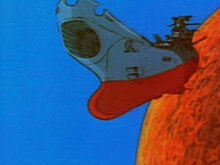
Another genre known equally mecha came into being at this time. Some early works include Mazinger Z (1972–1974), Science Ninja Squad Gatchaman (1972–1974), Infinite Battleship Yamato (1974–75) and Mobile Arrange Gundam (1979–80).
Equally a contrast to the activity-oriented shows, shows for a female audition such equally Candy Candy and The Rose of Versailles earned high popularity on Japanese television and later in other parts of the world.[forty]
By 1978, over fifty shows were aired on television.[43]
1980s [edit]
In the 1980s, anime started to get through a "visual quality renewal" thanks to new directors like Hayao Miyazaki, who founded Studio Ghibli in 1985, Isao Takahata and Katsuhiro Ōtomo.[ix] Anime began to deal with more nuanced and complex stories, while Boy's Love continued to impact cultural norms, taking root beyond East Asia, equally countries such as South korea, Thailand, and China ingested these Japanese popular culture exports.[44] [45] : 3 The shift towards infinite operas became more pronounced with the commercial success of Star Wars (1977). This immune for the space opera Space Battleship Yamato (1974) to be revived every bit a theatrical film. Mobile Suit Gundam (1979) was also successful and revived as a theatrical film in 1982. The success of the theatrical versions of Yamato and Gundam is seen every bit the get-go of the anime blast of the 1980s, and of "Japanese Cinema'southward Second Golden Age".[46]
A subculture in Japan, whose members later called themselves otaku, began to develop around animation magazines such every bit Animage and Newtype. These magazines formed in response to the overwhelming fandom that adult around shows such as Yamato and Gundam in the tardily 1970s and early on 1980s.
In the United States, the popularity of Star Wars had a similar, though much smaller, effect on the development of anime.[ commendation needed ] Gatchaman was reworked and edited into Battle of the Planets in 1978 and once more equally G-Force in 1986. Space Battleship Yamato was reworked and edited into Star Blazers in 1979. The Macross serial began with The Super Dimension Fortress Macross (1982), which was adapted into English every bit the first arc of Robotech (1985), which was created from three separate anime titles: The Super Dimension Fortress Macross, Super Dimension Cavalry Southern Cantankerous and Genesis Climber Mospeada. The sequel to Mobile Suit Gundam, Mobile Adapt Zeta Gundam (1985), became the most successful real robot space opera in Japan, where it managed an average goggle box rating of half dozen.6% and a top of 11.7%.[47]
The otaku subculture became more than pronounced with Mamoru Oshii's accommodation of Rumiko Takahashi's popular manga Urusei Yatsura (1981). Yatsura made Takahashi a household name and Oshii would break away from fan culture and take a more than auteuristic arroyo with his 1984 film Urusei Yatsura ii: Beautiful Dreamer. This break with the otaku subculture would let Oshii to experiment further.
The otaku subculture had some effect on people who were entering the industry around this fourth dimension. The near famous of these people were the apprentice product group Daicon Films which would become Gainax. Gainax began by making films for the Daicon science fiction conventions and were then popular in the otaku customs that they were given a chance to captain the biggest-approaching anime moving picture (at that time), Royal Space Force: The Wings of Honnêamise (1987).
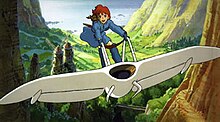
One of the most-influential anime of all fourth dimension, Nausicaä of the Valley of the Air current (1984), was fabricated during this menstruation. The film gave extra prestige to anime assuasive for many experimental and ambitious projects to be funded shortly after its release. Information technology too allowed managing director Hayao Miyazaki and his longtime colleague Isao Takahata to create their ain studio under the supervision of one-time Animage editor Toshio Suzuki. This studio would become known as Studio Ghibli and its first moving-picture show was Laputa: Castle in the Sky (1986), i of Miyazaki'southward near-ambitious films.
The success of Dragon Ball (1986) introduced the martial arts genre and became incredibly influential in the Japanese Animation manufacture. It influenced many more martial arts anime and manga series' including Hajime no Ippo (1989), Baki the Grappler (1991), Naruto (2002), and The God of Highschool (2020).
The 1980s brought anime to the home video market in the grade of original video animation (OVA), equally shows were shifting from a focus on superheroes to robots and space operas,[24] with original video animation (OVA or OAV) coming onto the marketplace in 1984, with a range in length.[13] Home videos opened up the floodgates, introducing viewers, particularly those in the West, to anime films.[35] Although anime was widely distributed through international piracy in the 1980s and 1990s,[37] before the days of online piracy, it continued to survive. Anime recovered in the U.South., condign more of Japan's tv exports as the country became the "earth'southward leading authority" in entertainment.[26] : 19–20 The first OVA was Mamoru Oshii's Dallos (1983–1984). Shows such as Patlabor had their beginnings in this market and it proved to exist a way to test less-marketable animation against audiences. The OVA allowed for the release of pornographic anime such every bit Cream Lemon (1984); the start hentai OVA was actually the little-known Wonder Kids studio'southward Lolita Anime, besides released in 1984.
The 1980s also saw the affiliation of anime with video games. The airing of Red Photon Zillion (1987) and subsequent release of its companion game, is considered to have been a marketing ploy by Sega to promote sales of their newly released Master Organization in Japan.
Sports anime, as it is now known, made its debut in 1983 with an anime accommodation of Yoichi Takahashi's soccer manga Captain Tsubasa, which became the beginning worldwide successful sports anime. Its themes and stories were a formula that would exist used in many sports series that followed, such equally Slam Douse, Prince of Tennis and Eyeshield 21.
The late 1980s saw an increasing number of high-upkeep and experimental films. In 1985, Toshio Suzuki helped put together funding for Oshii's experimental film Affections's Egg (1985). Theatrical releases became more ambitious, each film trying to outclass or outspend its predecessors, taking cues from Nausicaä 's popular and critical success. Night on the Galactic Railroad (1985), Tale of Genji (1986), and Grave of the Fireflies (1988) were all ambitious films based on important literary works in Japan. Films such equally Char'south Counterattack (1988) and Arion (1986) were lavishly approaching spectacles. This catamenia of lavish budgeting and experimentation would reach its zenith with two of the near-expensive anime film productions e'er: Royal Space Force: The Wings of Honneamise (1987) and Akira (1988). Studio Ghibli's Kiki's Delivery Service (1989) was the meridian-grossing film for 1989, earning over $forty meg at the box role.
Despite the commercial failure of Akira in Nippon, it brought with it a much larger international fan base for anime. When shown overseas, the moving-picture show became a cult hit and, eventually, a symbol of the medium for the W. The domestic failure and international success of Akira, combined with the bursting of the bubble economy and Osamu Tezuka's decease in 1989, marked the end of the 1980s era of anime.
1990s [edit]
Neon Genesis Evangelion [edit]
In 1995, Hideaki Anno wrote and directed the controversial anime Neon Genesis Evangelion. This prove became popular in Japan among anime fans and became known to the general public through mainstream media attending. It is believed that Anno originally wanted the show to be the ultimate otaku anime, designed to revive the failing anime manufacture, but midway through production he also made it into a heavy critique of the subculture. It culminated in the successful simply controversial film The Finish of Evangelion which grossed over $10 meg in 1997. The many violent and sexual scenes in Evangelion acquired Television set Tokyo to increase censorship of anime content. As a result, when Cowboy Bebop was first broadcast in 1998, it was shown heavily edited and only one-half the episodes were aired; it too gained heavy popularity both in and outside of Japan.
Evangelion started a series of then-called "post-Evangelion" or "organic" mecha shows. Most of these were giant robot shows with some kind of religious or complex plot. These include RahXephon, Brain Powerd, and Gasaraki. It as well led to tardily-night experimental anime shows. Starting with Serial Experiments Lain (1998), tardily dark became a forum for experimental anime such equally Boogiepop Phantom (2000), Texhnolyze (2003) and Paranoia Amanuensis (2004). Experimental anime films were also released in the 1990s, almost notably the cyberpunk thriller Ghost in the Vanquish (1995),[48] which had a stiff influence on The Matrix.[49] [l] [51] Ghost in the Shell, alongside Evangelion and the neo-noir space Western Cowboy Bebop, helped further increase the awareness of anime in international markets.[52]
The late 1990s as well saw a brief revival of the super robot genre that had decreased in popularity due to the rise of real robot and psychological mecha shows like Gundam, Macross, and Evangelion. The revival of the super robot genre began with Brave Exkaiser in 1990, and led to remakes and sequels of 1970s super robot shows like Getter Robo Go and Tetsujin-28 go FX. At that place were very few popular super robot shows produced later on this, until Tengen Toppa Gurren Lagann in 2007.
Gundam [edit]
Aslope its super robot analogue, the existent robot genre was also declining during the 1990s. Though several Gundam shows were produced during this decade, very few of them were successful. The but Gundam shows in the 1990s which managed an boilerplate television rating over 4% in Japan were Mobile Fighter One thousand Gundam (1994) and New Mobile Study Gundam Wing (1995). It wasn't until Mobile Adjust Gundam SEED in 2002 that the real robot genre regained its popularity.[47]
Princess Mononoke [edit]

In 1997, Hayao Miyazaki's Princess Mononoke became the about-expensive anime moving picture up until that time, costing $20 million to produce. Miyazaki personally checked each of the 144,000 cels in the movie,[53] and is estimated to take redrawn parts of 80,000 of them.[54] 1997 was besides the year of Satoshi Kon's debut, Perfect Blue, which won "All-time Film" and "Best Blitheness" awards at Montreal'due south 1997 Fantasia Festival, It too won awards in Portugal's Fantasporto Motion-picture show Festival.
End Of The Decade [edit]
Past 1998, over one hundred anime shows were aired on television in Japan,[43] including a popular series based on the Pokémon video game franchise. Other 1990s anime series which gained international success were Dragon Ball Z, Sailor Moon, and Digimon; the success of these shows brought international recognition to the martial arts superhero genre, the magical girl genre, and the action-chance genre, respectively. In particular, Dragon Ball Z and Sailor Moon were dubbed into more than than a dozen languages worldwide. Another big success was the anime One Slice, based on the best-selling manga of all time, which is withal ongoing.
2000s [edit]
The "Evangelion-era" trend continued into the 2000s with Evangelion-inspired mecha anime such every bit RahXephon (2002) and Zegapain (2006) – RahXephon was as well intended to help revive 1970s-way mecha designs. The number of anime productions began to decline after peaking in 2006 due to alternative forms of entertainment, less ad revenue, and other reasons, with Television receiver Tokyo remaining one of the only channels ambulation anime shows.[fifteen] Nevertheless, anime began entering U.Southward. homes like never earlier, with fans able to get their hands on Japanese-language originals of anime they watched, thanks to the cyberspace.[55]
The real robot genre (including the Gundam and Macross franchises), which had declined during the 1990s, was revived in the early on 2000s with the success of shows such as FLCL (2000), Mobile Suit Gundam SEED (2002), Eureka Seven (2005), Code Geass: Lelouch of the Rebellion (2006), Mobile Adjust Gundam 00 (2007), and Macross Frontier (2008).[56]
The 1970s-style super robot genre revival began with GaoGaiGar in 1997 and continued into the 2000s, with several remakes of archetype series such equally Getter Robo and Dancougar, equally well as original titles created in the super robot mold like Godannar and Gurren Lagann. Gurren Lagann in item combined the super robot genre with elements from 1980s real robot shows, also as 1990s "post-Evangelion" shows. Gurren Lagann received both the "all-time television production" and "best character design" awards from the Tokyo International Anime Fair in 2008.[57] This eventually culminated in the release of Shin Mazinger in 2009, a full-length revival of the commencement super robot serial, Mazinger Z.
An art movement started past Takashi Murakami that combined Japanese pop-civilisation with postmodern art chosen Superflat began effectually this time. Murakami asserts that the movement is an assay of post-war Japanese culture through the eyes of the otaku subculture. His desire is also to get rid of the categories of 'high' and 'low' fine art making a flat continuum, hence the term 'superflat'. His art exhibitions have gained popularity overseas and have influenced a scattering of anime creators, especially those from Studio iv °C.[58]
The experimental late night anime trend popularized by Serial Experiments Lain too continued into the 2000s with experimental anime such as Boogiepop Phantom (2000), Texhnolyze (2003), Paranoia Amanuensis (2004), Gantz (2004), and Ergo Proxy (2006)
Before the massive boom from companies similar Funimation and Developed Swim, view or even obtaining anime in the United States was quite difficult. since the market value and the involvement in the states as quite depression many broadcasting companies would not bother with airing the shows. This was due to a number of factors one of which was getting the bear witness translated. In the modern we accept anime that is dubbed over with English voices making it easier for western audiences. However in the early 90's when anime was starting time stating to become big that was not bachelor. Many fans of the genre would interpret the show them selves and would post them online for others to view.[59] This trend would continue until September two, 2001. This is when the evidence Cowboy Bebop first aired on the wide casting network Developed Swim and was the beginning anime to be broadcast on live television.[lx] The show as an instant successes the only problem being the air time was late and dark meaning that the audience was subject to a small amount of people.[61]
In addition to these experimental trends, the 2000s were also characterized past an increase of moe-style art and bishōjo and bishōnen graphic symbol design. At that place was a rising presence and popularity of genres such equally romance, harem and slice of life.
Anime based on eroge and visual novels increased in popularity in the 2000s, building on a trend started in the late 1990s past such works as Sentimental Journey (1998) and To Centre (1999). Examples of such works include Green Green (2003), SHUFFLE! (2006), Kanon (2002 and 2006), Fate/Stay Night (2006), Higurashi no Naku Koro ni (2006), Ef: A Tale of Memories (2007), True Tears (2008), and Clannad (2008 and 2009).
Many shows have been adjusted from manga and lite novels, including popular titles such as Yu-Gi-Oh! (2000), Inuyasha (2000), Naruto and its sequel series Naruto Shippuden (2002 and 2007), Fullmetal Alchemist and its manga faithful accommodation Fullmetal Alchemist: Brotherhood (2003 and 2009), Monster (2004), Bleach (2004), Rozen Maiden (2005), Aria the Animation (2005), Shakugan no Shana (2005), Pani Poni Dash! (2005), Death Note (2006), Mushishi (2006), Sola (2007), The Melancholy of Haruhi Suzumiya (2006), Lucky Star (2007), Toradora! (2008), Thousand-On! (2009), Bakemonogatari (2009), and Fairy Tail (2009); these shows typically last several years and achieve big fanbases. Even so, original anime titles keep to be produced with the same success.
The 2000s marked a trend of emphasis of the otaku subculture. A notable critique of this otaku subculture is found in the 2006 anime Welcome to the N.H.K., which features a hikikomori (socially withdrawn) protagonist and explores the furnishings and consequences of various Japanese sub-cultures, such equally otaku, lolicon, cyberspace suicide, massively multiplayer online games and multi-level marketing.
In dissimilarity to the to a higher place-mentioned phenomenon, in that location take been more than productions of late-night anime for a non-otaku audience as well. The beginning concentrated try came from Fuji Telly's Noitamina cake. The thirty-minute belatedly-Thursday timeframe was created to showcase productions for young women of college historic period, a demographic that watches very trivial anime. The kickoff product Love and Clover was a particular success, peaking at a 5% Telly rating in Kantou, very potent for late-dark anime. The block has been running uninterrupted since April 2005 and has yielded many successful productions unique in the modern anime marketplace.
In that location accept been revivals of American cartoons such as Transformers which spawned four new series, Transformers: Car Robots in 2000, Transformers: Micron Fable in 2003, Transformers: Superlink in 2004, and Transformers: Milky way Force in 2005. In addition, an anime adaptation of the M.I Joe serial was produced titled K.I. Joe: Sigma 6.
The revival of earlier anime series was seen in the forms of Fist of the N Star: The Legends of the True Savior (2006) and Dragon Ball Z Kai (2009). Afterward series also started receiving revivals in the belatedly 2000s and early 2010s, such as with Studio Khara'south Rebuild of Evangelion tetralogy (2007–2021), and new adaptations of Masamune Shirow's manga Appleseed XIII (2011) and Ghost in the Beat: Arise (2013–2016).
The decade besides dawned a revival of high-upkeep feature-length anime films, such equally Millennium Actress (2001), Metropolis (2001), Appleseed (2001), Paprika (2006), and the most expensive of all being Steamboy (2004) which cost $26 million to produce. Satoshi Kon established himself aslope Otomo and Oshii as ane of the premier directors of anime pic, before his premature death at the historic period of 46. Other younger motion picture directors, such every bit Mamoru Hosoda, director of The Girl Who Leapt Through Fourth dimension (2006) and Summer Wars (2009), as well began to accomplish prominence.
During this decade, anime feature films were nominated for and won major international film awards for the beginning time in the industry's history. In 2002, Spirited Away, a Studio Ghibli production directed by Hayao Miyazaki, won the Golden Carry at the Berlin International Film Festival and in 2003 at the 75th Academy Awards information technology won the Academy Honor for All-time Animated Characteristic. Information technology was the first non-American film to win the award and is 1 of merely two to exercise so. Information technology has besides get the highest grossing anime moving picture, with a worldwide box part of U.s.$274 million.
Following the launch of the Toonami programming cake on Cartoon Network in the Usa in March 1997, anime saw a behemothic rise in the Due north American market. Kid-friendly anime such as Pokémon, Yu-Gi-Oh!, Digimon, Doraemon, Bakugan, Beyblade, Sonic Ten, and the 4Kids Entertainment adaptation of One Piece have all received varying levels of success. This era also saw the rise of Anime-influenced blitheness, most notably Avatar: the Last Airbender and its sequel The Legend of Korra, Megas XLR, Code Lyoko, Ben 10, Chaotic, Samurai Jack, The Town, RWBY and Teen Titans. As such, anime further became entrenched in U.S. households with the launch of Adult Swim by Cartoon Network in 2001, aimed at those in the "older OVA & tape trading crowd," with a new fandom forming.[62] This fandom was, however, exclusive and elitist with newcomers expected to know how to utilize IRC, some basic Japanese, and then on.
At the 2004 Cannes Flick Festival, Ghost in the Trounce 2: Innocence, directed by Mamoru Oshii, was in competition for the Palme d'Or and in 2006, at the 78th Academy Awards, Howl's Moving Castle, another Studio Ghibli-produced moving-picture show directed by Hayao Miyazaki, was nominated for Best Animated Feature. 5 Centimeters Per Second, directed by Makoto Shinkai, won the countdown Asia Pacific Screen Award for Best Animated Feature Picture in 2007, and then far, anime films take been nominated for the award every year.
By 2004, over two hundred shows were aired on television.[43]
In 2006, graduates of the University of California, Berkeley launched Crunchyroll in 2006,[63] becoming the first "anime streaming service," a model later used by Netflix, Funimation, and Amazon.com in the afterward 2010s.
2010s [edit]
In May 2012, the Toonami programming block in the United States was relaunched as a late nighttime adult-oriented action block on Developed Swim, bringing more uncut pop anime dorsum to a wider audience on cable television. In improver to broadcasting or re-broadcasting previously released dubbed anime, the block (equally well as Adult Swim itself) has overseen the worldwide premiere of English language dubbed releases for various anime, including but not express to: Durarara!! (2010), Deadman Wonderland (2011), Hunter x Hunter (2011), Sword Art Online (2012), JoJo's Bizarre Run a risk (2012), Attack on Titan (2013), Kill la Kill (2013), Space Dandy (2014), Akame ga Kill! (2014), Parasyte -the maxim- (2014), Ane-Punch Man (2015), Dragon Ball Super (2015), Boruto: Naruto Next Generations (2017), and Demon Slayer: Kimetsu no Yaiba (2019).[64]
On September vi, 2013 Hayao Miyazaki appear that The Current of air Rises (2013) would exist his last film, and on August 3, 2014 it was announced that Studio Ghibli was "temporarily halting product" following the release of When Marnie Was There (2014), further substantiating the finality of Miyazaki's retirement. The disappointing sales of Isao Takahata's improvement film The Tale of Princess Kaguya (2013) has besides been cited as a factor.[65] Several prominent staffers, including producer Yoshiaki Nishimura and managing director Hiromasa Yonebayashi, left to course their ain Studio Ponoc, premièring with Mary and the Witch's Flower (2017).[66] [67] [68] Both Ghibli and Miyazaki subsequently went back into production for the upwardly-coming motion picture How Do You Live?,[69] while Takahata died on Apr 5, 2018 of lung cancer.[70]
Diverse international anime distribution companies, such as ADV Films, Bandai Entertainment, and Geneon Entertainment, were close downwards due to poor acquirement, with their assets spun into new companies like Sentai Filmworks or given to other companies.[71]
In 2011, Puella Magi Madoka Magica was aired in Japan. The anime was a change from normal magical girl anime, as this anime independent more than darker, circuitous and more gorier themes than magical anime unremarkably would. The anime got great reception from critics, as Britain's Anime Network'due south Andy Hanley rated information technology a 10 out of 10 for its emotional content and evocative soundtrack.
Both Set on on Titan and The Wind Rises reverberate a national argue surrounding the reinterpretation of Article 9 of the Constitution of Japan, with Miyazaki'due south pacifism in the motion-picture show coming under burn down from the political right,[72] while Attack on Titan has been defendant of promoting militarism by people in neighboring Asian countries, despite beingness intended to show the haunting, hopeless aspects of conflict.[73] The mecha anime genre (every bit well as Japanese kaiju films) received a Western homage with the 2013 film Pacific Rim directed by Guillermo del Toro.[74]
Western streaming services such as Netflix and Amazon Prime are increasingly becoming involved in the production and licensing of anime for the international markets.[75] [76]
In 2015, an all-record-loftier of three hundred twoscore anime series aired on television.[43]
2020s [edit]
The international popularity and demand of anime highly rose upward during the Covid-19 pandemic due to the medium's increased availability on streaming services.[77] [78]
Demon Slayer: Kimetsu no Yaiba the Movie: Mugen Railroad train became the highest-grossing Japanese film and the world's highest-grossing films of 2020.[79] It likewise became the fastest grossing film in Japanese cinema, because in ten days it made ten billion yen ($95.3m; £72m).[79] It beat the previous record of Spirited Away which took 25 days.[79]
In 2021, the anime adaptations of Jujutsu Kaisen, Demon Slayer: Kimetsu no Yaiba and Tokyo Revengers were among the top 10 most discussed Tv set shows worldwide on Twitter.[fourscore] [81]
In 2022, Attack on Titan won the award of "Most In-Demand Television set Series in the Earth 2021" in the Global TV Demand Awards. Attack on Titan became the commencement ever non-English language series to earn the title of World'southward Well-nigh In-Need Tv set Show, previously held by just The Walking Expressionless and Game of Thrones.[82]
Firsts [edit]
| First... | Native linguistic communication name | English name | Released | Type |
|---|---|---|---|---|
| Anime (oldest known) | 活動写真 | Katsudō Shashin | Unknown; believed to be about 1911[a] | Short Film |
| Confirmed film release | 凸坊新画帳・名案の失敗 | Bumpy new moving-picture show book – Failure of a dandy plan | February 1917[1] | Short Film |
| Anime publicly shown in a theater | 芋川椋三玄関番の巻 or 芋川椋三玄関番之巻 | The Story of the Concierge Mukuzo Imokawa | Apr 1917[1] | Curt Moving-picture show |
| Talkie | 力と女の世の中 | Within the Globe of Ability and Women [b] | April 13, 1933[83] | Moving picture |
| Entirely cel-animated anime | 茶釜音頭 | The Dance of the Chagamas | 1934[20] | Film |
| Feature pic | 桃太郎 海の神兵 | Momotaro: Sacred Sailors [c] | April 12, 1945[84] | Flick |
| Appearance on television (non series) | もぐらのアバンチュール | Mole's Adventure | July fourteen, 1958[85] | Brusque Picture show |
| Color characteristic film | 白蛇伝 | The Tale of the White Serpent | October 22, 1958 | Film |
| Telly series | インスタントヒストリー | Instant History | May 1, 1961 | Series |
| Showtime Popular Television serial Worldwide | 鉄腕アトム | Astro Boy | Jan 1, 1963 | Series |
| Belatedly night series | 仙人部落 | Hermit Hamlet | September iv, 1963 | Series |
| Giant robot series | 鉄人28号 | Tetsujin 28-go | October xx, 1963 | Serial |
| Color idiot box series | ジャングル大帝 | Kimba the White King of beasts | October half-dozen, 1965 | Series |
| Magical girl series | 魔法使いサリー | Sally the Witch | December five, 1966 | Series |
| Sports series | 巨人の星 | Star of the Giants | March 30, 1968 | Series |
| Adult-oriented (animated) film | 千夜一夜物語 | A One thousand and Ane Nights | June fourteen, 1969 | Film |
| Hentai with an "Ten rating"[d] | クレオパトラ | Cleopatra | September 15, 1970[86] | Film |
| Space opera serial | 宇宙戦艦ヤマト | Space Battleship Yamato | Oct half-dozen, 1974 | Series |
| Isekai series | 聖戦士ダンバイン | Aureola Battler Dunbine | February 5, 1983 | Serial |
| OVA | ダロス | Dallos | December 12, 1983 | OVA |
| Cyberpunk series | ビデオ戦士レザリオン | Video Warrior Laserion | March 4, 1984 | Series |
| First Popular Worldwide Moving-picture show | アキラ | Akira | July 16, 1988 | Film |
| Animation with CGI Effects | こうかくきどうたい | Ghost in the Shell | Nov 18, 1995 | Movie |
| Fully computer animated anime[87] | A.LI.CE | A.LI.CE | February 5, 2000 | Film |
| ONA | 無限のリヴァイアス イリュージョン | Infinite Ryvius: Illusion | June 30, 2000 | ONA |
Records [edit]
| Record... | Native language name | English name | Released | Blazon |
|---|---|---|---|---|
| Highest grossing anime film in Nihon | 劇場版「鬼滅の刃」 無限列車編 | Demon Slayer: Kimetsu no Yaiba the Movie: Mugen Railroad train | October 16, 2020 | Movie |
| Fastest grossing anime flick[79] | 劇場版「鬼滅の刃」 無限列車編 | Demon Slayer: Kimetsu no Yaiba the Pic: Mugen Train | Oct 16, 2020 | Film |
| Highest grossing anime motion-picture show worldwide | 劇場版「鬼滅の刃」 無限列車編 | Demon Slayer: Kimetsu no Yaiba the Moving-picture show: Mugen Train | Oct 16, 2020 | Film |
See also [edit]
- History of manga
- Kamishibai
Notes [edit]
- ^ Katsudō Shashin is idea to have been made sometime between 1907 and 1911. Information technology is not known if this picture was ever publicly displayed or released as evidence suggests it was mass-produced to be sold to wealthy owners of abode projectors.
- ^ Likewise referred to every bit The World of Power and Women.
- ^ As well referred to as Momotaro's Divine Sea Warriors or Momotaro: God Warriors of the Bounding main.
- ^ Near erotic works take been retroactively tagged every bit "hentai" since the coining of the term in English. As such, in that location is no agreed upon first hentai series or film.
References [edit]
- ^ a b c d e f grand Litten, Frederick S. (June 2014). "On the Earliest (Foreign) Animation Films Shown in Japanese Cinema" (PDF). Frederick Due south. Litten's website. Frederick South. Litten. Archived (PDF) from the original on December 27, 2019. Retrieved February 17, 2021. This commodity, past a German researcher, was first published on January 4, 2013 in The Japanese Journal of Blitheness Studies, vol. 15, no.1A, 2013, pp. 27-32
- ^ "What is Utsushi-e?". world wide web.f.waseda.jp.
- ^ "Taneita(Slides)". world wide web.f.waseda.jp.
- ^ Reuters staff; reporting past Linda Sieg (March 27, 2008). "Japan finds films by early "anime" pioneers". reuters.com. Archived from the original on December 14, 2019. Retrieved January 5, 2021.
{{cite web}}: CS1 maint: multiple names: authors list (link) - ^ a b c d east f g h Novielli, Maria Roberta (2018). Floating worlds : a short history of Japanese animation. Boca Raton. ISBN978-1-351-33482-two. OCLC 1020690005.
- ^ "Oldest anime institute". Anime News Network . Retrieved July 16, 2013.
- ^ "China People's Daily Online (Japanese Edition): 日本最古?明治時代のアニメフィルム、京都で発". Retrieved March five, 2007.
- ^ Sieg, Linda (March 27, 2008). "Nihon finds films by early "anime" pioneers". Reuters. Archived from the original on Jan fourteen, 2020. Retrieved March 28, 2020.
- ^ a b c d "A pocket-size glimpse into the history of Japanese anime". Go! Get! Nihon. Oct 27, 2008. Archived from the original on March 27, 2020. Retrieved March 28, 2020.
- ^ "Archived copy". Archived from the original on June 16, 2008. Retrieved July 23, 2008.
{{cite web}}: CS1 maint: archived copy as title (link) - ^ "Urashima Tarō (supposed title) [digitally restored version]". Japanese Animated Movie Classics. National Museum of Modern Art, Tokyo. Retrieved October v, 2017.
- ^ Crow, Jonathan (June xiv, 2014). "Early Japanese Animations: The Origins of Anime (1917–1931)". Open Culture. Open Culture, LLC. Archived from the original on March 27, 2020. Retrieved March 28, 2020.
- ^ a b c d Patten, Fred (August 2016). "A Sheathing History of Anime". Animation World Magazine. Van Nuys, CA: Blitheness Earth Network. Archived from the original on March 27, 2020. Retrieved March 28, 2020.
- ^ Yamaguchi, Katsunori; Watanabe, Yasushi (1977). Nihon animēshon eigashi. Yūbunsha. pp. 26–27.
- ^ a b c d Yasuo, Yamaguchi (November 28, 2013). "The Evolution of the Japanese Anime Industry". nippon.com. Archived from the original on March 4, 2020. Retrieved March 28, 2020.
- ^ Precipitous, Jasper (2009). "The First Frames of Anime". The Roots of Japanese Anime, official booklet, DVD.
- ^ Yamaguchi, Katsunori; Watanabe, Yasushi (1977). Nihon animēshon eigashi. Yūbunsha. pp. 20–21.
- ^ Baricordi, Andrea; D'Opera, Adeline; Pelletier, Claude J. (2000). Anime: A guide to Japanese Animation, 1958-1988 (1 ed.). Montréal: Protoculture Inc. p. 12. ISBNii-9805759-0-9.
- ^ Campbell, Alan (1994). Japan: An Illustrated Encyclopedia (1st ed.). Tokyo: Kodansha. ISBN978-4-06-206489-7. [ page needed ]
- ^ a b Precipitous, Jasper (September 23, 2004). "Pioneers of Japanese Animation (Part 1)". Midnight Eye. Retrieved Dec x, 2009.
- ^ The Roots of Japanese Anime, official booklet, DVD.
- ^ Yamaguchi, Katsunori (1977). Nihon animēshon eigashi. Yūbunsha. pp. 34–37.
- ^ Yamaguchi, Katsunori (1977). Nihon animēshon eigashi. Yūbunsha. pp. 38–44.
- ^ a b c d Coutte, Aileen (December xviii, 2013). "The History of Anime" (PDF). San Francisco State University. Archived (PDF) from the original on March 27, 2020. Retrieved March 28, 2020.
- ^ Reed, Gabrielle (April 5, 2017). "The Surprising Affect of Earth State of war Two Propaganda Animation Pattern". Ethos3. Archived from the original on March 28, 2020. Retrieved March 28, 2020.
- ^ a b Carter, Laz (November 2011). "Introduction: What Is Anime? Why Anime? Where Is Anime?". Globalisation in Contemporary Anime: An Analysis of the Multiple Platform Pokémon Franchise (PhD). School of Oriental and African Studies. Retrieved March 28, 2020.
- ^ "A Yiddishe Manga: The Artistic Roots of Nihon's God of Comics" (PDF). Innovative Research in Japanese Studies. Wix. Retrieved July 17, 2014.
- ^ Patten, Fred (2004). Watching Anime, Reading Manga: 25 Years of Essays and Reviews. Stone Bridge Press. p. 144. ISBN9781611725100.
- ^ Meixler, Eli (April 5, 2018). "The Japanese Animation Director and Studio Ghibli Co-Founder Isao Takahata Has Died". Fourth dimension. Archived from the original on June ane, 2019. Retrieved March 28, 2020.
- ^ a b Clements, Jonathan; McCarthy, Helen (2014). Anime Encyclopedia: A century of japanese animation. Stone Bridge Printing. p. 616. ISBN978-1-61172-018-1.
- ^ a b Clements, Jonathan (2013). Anime: A History. London: British Film Institute. ISBN978-1-84457-390-5.
- ^ Tezuka, Osamu; Schodt, Frederik L.; Chameleon, Digital (2002). Astro Boy (1st ed.). Milwaukie, OR: Dark Horse Manga. p. two (Intro). ISBNane-56971-676-5.
- ^ "Astro Boy not the First Anime". Anime News Network . Retrieved April 27, 2016.
- ^ a b Bond, Jean-Michael (April 6, 2018). "Why anime is more than popular now than ever". The Daily Dot. Archived from the original on March 27, 2020. Retrieved March 28, 2020.
- ^ a b Ruh, Brian (2010). "Transforming U.S. Anime in the 1980s: Localization and Longevity". Mechademia. 5 . Retrieved March 28, 2020.
- ^ a b Chambers, Samantha Nicole Inëz (2010). "Anime: From Cult Following to Pop Culture Phenomenon" (PDF). The Elon Journal of Undergraduate Inquiry in Communications. three (2). Retrieved March 28, 2020.
- ^ a b "The Mike Toole Evidence: Old's Cool". Retrieved October i, 2016.
- ^ D., Totman, Conrad (September 11, 2014). A history of Japan (2d ed.). Malden, Massachusetts. ISBN9781119022336. OCLC 893678853.
- ^ a b Bendazzi, Giannalberto (October 23, 2015). Animation: A World History: Volume Two: The Birth of a Style - The Three Markets. CRC Press. ISBN9781317519911. [ page needed ]
- ^ "Anime in Europe". February 2, 2015. Archived from the original on February 2, 2015. Retrieved January 25, 2016.
- ^ O'Rourke, Jill (October 11, 2018). "The Erasure Of LGBTQ Characters In Children'due south Media Goes Beyond Bert And Ernie". A Plus. Archived from the original on March 28, 2020. Retrieved March 28, 2020.
- ^ a b c d "Anime Industry Data | 日本動画協会".
- ^ Ureta, Rhys (January 21, 2020). "Making History: The Rose of Versailles". Futekiyablog. FANTASISTA,INC. Archived from the original on March 26, 2020. Retrieved March 28, 2020.
- ^ Mazariegos, Edgar Santiago Peláez (2019). "The global "craze" for Japanese popular culture during the 1980s and 1990s: The influence of Anime and Manga in United mexican states". Iberoamericana. 41 (1). Retrieved March 28, 2020.
- ^ Kehr, Dave (January 20, 2002). "FILM; Anime, Japanese Cinema's Second Golden Historic period". The New York Times . Retrieved September 25, 2016.
- ^ a b "Gunota Headlines". Aeug.blogspot.com. Retrieved September 25, 2016.
- ^ "Megazone 23". A.D. Vision. Retrieved May 5, 2008.
- ^ Joel Silver, interviewed in "Scrolls to Screen: A Brief History of Anime" featurette on The Animatrix DVD.
- ^ Joel Silver, interviewed in "Making The Matrix" featurette on The Matrix DVD.
- ^ "Archived re-create". Archived from the original on May 17, 2006. Retrieved May 28, 2010.
{{cite web}}: CS1 maint: archived copy as title (link) - ^ Verboon, Nick (June 13, 2013). "90'due south Flashback: Neon Genesis Evangelion". Unreality Mag. Archived from the original on December vii, 2014. Retrieved November 17, 2013.
- ^ "TNT's Crude Cut - Princess Mononoke - Hayao Miyazake Transcript 11/4/1999". Princess Mononoke. April eleven, 1999. Retrieved September 26, 2016.
- ^ "Studio Ghibli | Disney Video". Disney.go.com. Retrieved September 26, 2016.
- ^ Dietsch, Drew (December 8, 2017). "The History of Anime's Journeying to America". Fandom. Archived from the original on April 22, 2020. Retrieved April 25, 2020.
- ^ "Best Anime of the 2000s | The Bamboozlement". Retrieved May 22, 2021.
- ^ "Eva 1.0 Wins Tokyo Anime Fair's Blitheness of the Yr". Anime News Network. February 26, 2008. Retrieved February 26, 2008.
- ^ "Takashi Murakami | Japanese artist and entrepreneur". Encyclopedia Britannica . Retrieved May 22, 2021.
- ^ Daliot-Bul, Michael; Otmazgin, Nissim (January i, 2017). The Anime Boom in the U.s.a.. BRILL. doi:10.1163/9781684175819. ISBN978-1-68417-581-9.
- ^ Otmazgin, Nissim (2014). "Anime in the U.s.: The Entrepreneurial Dimensions of Globalized Culture". Pacific Affairs. 87: 53–69. doi:10.5509/201487153.
- ^ Kennell, Amanda (February 2016). "Origin and Ownership from Ballet to Anime". The Journal of Popular Culture. 49 (i): x–28. doi:x.1111/jpcu.12378. ISSN 0022-3840.
- ^ Ohno, John (May 22, 2019). "A brief history of anime fandom outside of Japan". Medium. Archived from the original on May 23, 2019. Retrieved April 25, 2020. Ohno is an author of various books in the area of computing, such every bit Big and Minor Computing: Trajectories for the Future of Software.
- ^ Rex, Steve (December 21, 2018). "Anime: The Touch on, the History, and the Controversy". The Skillful Men Project. Archived from the original on April 26, 2020. Retrieved Apr 25, 2020.
- ^ "Adult Swim Video". Adult Swim . Retrieved January 31, 2018.
- ^ O'Brien, Lucy (Baronial three, 2014). "Studio Ghibli May No Longer Exist Making Feature Films". IGN . Retrieved Baronial v, 2014.
- ^ "Ghibli Producer Yoshiaki Nishimura Works at New Studio". Anime News Network. June 16, 2015. Archived from the original on June 17, 2015. Retrieved December fifteen, 2016.
- ^ White, James (December 15, 2016). "Studio Ponoc aims to bring the Ghibli magic with Mary And The Witch'southward Flower". Empire. Archived from the original on December 17, 2016. Retrieved December fifteen, 2016.
- ^ "Former Ghibli Staffers' Studio Ponoc Unveils Mary and the Witch's Flower Anime Film". Anime News Network. December 15, 2016. Archived from the original on December 16, 2016. Retrieved December xv, 2016.
- ^ "Studio Ghibli reopens for Hayao Miyazaki's new flick". Engadget. Archived from the original on December 14, 2017. Retrieved March three, 2018.
- ^ Meixler, Eli (April 5, 2018). "Isao Takahata, Co-Founder of Japan's Studio Ghibli, Has Died". Time . Retrieved April 6, 2018.
- ^ "Animetaro". world wide web.facebook.com . Retrieved Oct 31, 2017.
- ^ Blum, Jeremy (August 13, 2013). "Animation legend Hayao Miyazaki under attack in Japan for anti-state of war film". South China Forenoon Post. SCMP Group. Retrieved December 11, 2013.
- ^ "A revival of militarism? Attack on Titan sparks Korean-Japanese spat (軍國主義復活?/進擊的巨人 引發韓日論戰)". The Liberty Times. Taipei. June 12, 2013. Retrieved June 27, 2013.
- ^ Axinto, Jemarc (April 24, 2014). "Pacific Rim: In-depth report of the influence of Anime". The Artifice. Retrieved November 14, 2014.
- ^ "Netflix is Currently Funding xxx Original Anime Productions". Forbes.
- ^ "Anime is one of the biggest fronts in the streaming wars". The Verge. December 23, 2019.
- ^ "The world is watching more than anime and streaming services are ownership". The Wall Street Journal. Nov 14, 2020.
- ^ "Streaming and covid-19 have entrenched anime's global popularity". The Economist. June 5, 2021.
- ^ a b c d "How a demon-slaying film is drawing Nippon dorsum to the cinemas". BBC. October 31, 2020. Archived from the original on November three, 2020.
- ^ "2021 #OnlyOnTwitter". Twitter. December 9, 2021.
- ^ "Jujutsu Kaisen Tops Squid Game, Wandavision in Social Media's 2021 Discussions". CBR. December nine, 2021.
- ^ "Anime and Asian series boss 4th Annual Global TV Need Awards, highlighting industry and consumer trends towards international content". WFMZ-Idiot box. Jan 25, 2022. Retrieved January 27, 2022.
- ^ 力と女の世の中 (1933) (in Japanese). AllCinema Motion picture & DVD Database. Retrieved May xx, 2009.
- ^ Jonathan Clements, Helen McCarthy. The Anime Encyclopedia: A Guide to Japanese Blitheness Since 1917. Revised and Expanded Edition.—Berkeley, CA: Stone Bridge Press, 2006.—P. 12.—ISBN 978-1933330105
- ^ "Oldest Tv Anime'due south Color Screenshots Posted". Anime News Network. June 19, 2013. Retrieved May 22, 2017.
- ^ Clements, Jonathan; McCarthy, Helen (2006). The Anime Encyclopedia: A Guide to Japanese Blitheness Since 1917 (Revised and Expanded ed.). Stone Span Press.
- ^ "Fantasia 2000 holds press conference". Anime News Network. July five, 2000. Retrieved January four, 2014.
Further reading [edit]
- Clements, Jonathan and Helen McCarthy (2001). The Anime Encyclopedia: A Guide to Japanese Animation Since 1917 (1st ed.). Rock Bridge Press. ISBNi-880656-64-vii.
- Clements, Jonathan and Barry Ip (2012) "The Shadow Staff: Japanese Animators in the Toho Aviation Instruction Materials Production Role 1939–1945" in Blitheness: An Interdisciplinary Periodical seven(2) 189–204.
- Drazen, Patrick (2003). Anime Explosion!: The What? Why? & Wow! of Japanese Blitheness. Stone Bridge Press. ISBN1-880656-72-eight.
- Ettinger, Benjamin "Karisuma Animators"
- Ettinger Benjamin "Toei Doga" (Part 2) Anipages Daily. July 25, 2004 and July 26, 2004.
- Miyazaki, Hayao trans. Ryoko Toyama "Nigh Japanese Animation"
- Murakami, Takashi (2003). Super Flat. Terminal Gasp. ISBN4-944079-20-vi.
- Okada, Toshio et al. (2005), "Otaku Talk". Trivial Boy: The Arts of Nihon's Exploding Subculture. Ed. Takashi Murakami. Japan Society and Yale University Press. ISBN 0-913304-57-3.
- Precipitous, Jasper "Pioneers of Japanese Animation at PIFan" Midnight Center September 25, 2004
- Richie, Donald (2005). A Hundred Years of Japanese Film: A Concise History, with a Selective Guide to DVDs and Videos. Kodansha America. ISBN4-7700-2995-0.
- Kime, Chad. "American Anime: Blend or Bastardization?" EX Online Anime Magazine.
External links [edit]
- HISTORY OF ANIME: Osamu Tezuka
Source: https://en.wikipedia.org/wiki/History_of_anime
0 Response to "Anime and Its Roots in Early Japanese Monster Art"
Post a Comment