Throwing Outofmemoryerror Pthread_create 1040kb Stack Failed Try Again
堆内存分配失败导致的 OOM
度量
采用下述 API 来度量 APP 或系统的内存使用情况
| 类别 | API | 说明 |
|---|---|---|
| APP | Runtime.maxMemory() | JVM 可以从系统那申请到的内存的最大值,ActivityManager.getMemoryClass() 和 ActivityManager.getLargeMemoryClass() 其中之一,超过此阈值会发生 OOM |
Runtime.totalMemory() | JVM 已申请到的内存大小,小于等于 Runtime.maxMemory() 且大于 Runtime.freeMemory();当需要的内存(比如创建 1M 的字节数组)超过 Runtime.freeMemory() 时 JVM 会向系统申请内存,此时 Runtime.totalMemory() 会逐渐增大;直到等于 Runtime.maxMemory() 时,如果需要的内存超过 Runtime.freeMemory() 则抛出 OOM | |
Runtime.freeMemory() | JVM 已申请到但仍未使用的内存,当需要的内存超过此值时,JVM 会向系统申请内存 | |
ActivityManager.getMemoryClass() | APP 可申请的内存上限 | |
ActivityManager.getLargeMemoryClass() | 设置 android:largeHeap="true" 后 APP 可申请的内存上限,一般是 ActivityManager.getLargeMemoryClass() 的两倍 | |
| 系统 | ActivityManager.MemoryInfo.availMem | 当前系统可用内存大小,即设置里可用运存的值 |
ActivityManager.MemoryInfo.totalMem | 系统总内存大小,即设置里运存总空间的值 | |
ActivityManager.MemoryInfo.lowMemory | 标识系统是否处于低内存状态 | |
ActivityManager.MemoryInfo.threshold | 当系统可用内存小于此阈值时,系统处于低内存状态 |
测试
使用下面的测试代码在我的测试机(iQOO 3)上,循环申请 30M/5M/500K 的内存,每次间隔 1s 并打印内存统计情况
可以看到 JVM 使用内存上限 max 是 256M(刚好是 memoryClass,如果配置了 largeHeap="true" 则是 largeMemoryClass),已申请内存 total 逐步上升直到 256M,full - free 等于申请内存的累计量;运行内存为 11.36GB,可用运存徘徊在 5GB 左右,当运存掉到 216M 时进入低内存状态,所以目前并不是低内存;APP 可申请内存上限为 256MB,设置 largeHeap="true" 后翻倍到 512MB
抛出 OOM 时的信息为:Failed to classify a 512016 byte allotment with 22760 costless bytes and 22KB until OOM, target footprint 268435456, growth limit 268435456
参考日志的最后一行,当时正在申请 500KB 的内存(Failed to allocate a 512016 byte allocation),还剩 xiv.95KB(with 22760 free bytes and 22KB until OOM),上限是 256MB(target footprint 268435456, growth limit 268435456)
// 循环申请内存直到 OOM fun mallocJVM () { val steps = arrayOf(1024L * 1024 * 30, 1024L * 1024 * 5, 1024L * 500) val pool = mutableListOf<ByteArray>() while (truthful) { val runtime = Runtime.getRuntime() val costless = runtime.maxMemory() - runtime.totalMemory() + runtime.freeMemory() val size = if (complimentary >= steps[0]) steps[0] else if (free >= steps[1]) steps[i] else steps[2] puddle += ByteArray(size = size.toInt()) look() printMemoryUsages() } } // 间隔 1s fun await (time: Long = one thousand) { lock.lock() endeavor { cond.await(time, TimeUnit.MILLISECONDS) } finally { lock.unlock() } } // 打印内存统计情况 fun printMemoryUsages () { val runtime = Runtime.getRuntime() am.getMemoryInfo(memInfo) d("max:${runtime.maxMemory} full:${runtime.totalMemory} free:${runtime.freeMemory} " + "availMem:${memInfo.availMemReadable} totalMem:${memInfo.totalMemReadable} " + "threshold:${memInfo.thresholdReadable} lowMemory:${memInfo.lowMemory} " + "memoryClass:${am.memoryClassReadable} largeMemoryClass:${am.largeMemoryClassReadable}") } 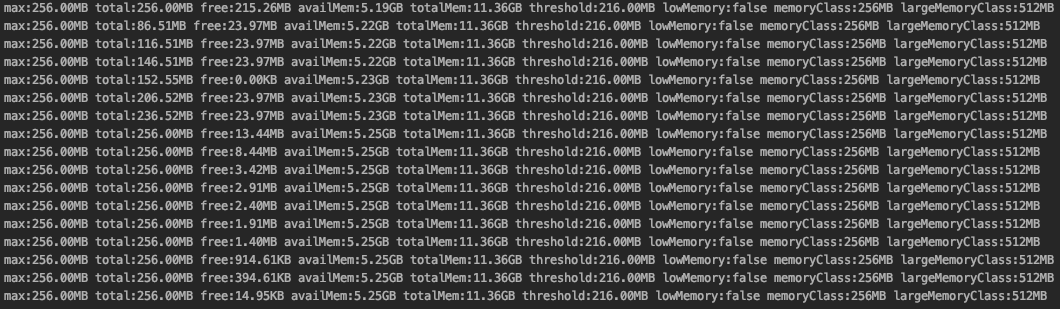

定位抛出 OOM 的位置
最终抛出 OutOfMemoryError 的代码 是 Thread::ThrowOutOfMemoryError
void Thread::ThrowOutOfMemoryError (const char* msg) { LOG(WARNING) << "Throwing OutOfMemoryError " << '"' << msg << '"' << " (VmSize " << GetProcessStatus("VmSize") << (tls32_.throwing_OutOfMemoryError ? ", recursive case)" : ")"); if (!tls32_.throwing_OutOfMemoryError) { tls32_.throwing_OutOfMemoryError = true; ThrowNewException("Ljava/lang/OutOfMemoryError;", msg); tls32_.throwing_OutOfMemoryError = false; } else { Dump(LOG_STREAM(WARNING)); // The pre-allocated OOME has no stack, so help out and log i. SetException(Runtime::Electric current()->GetPreAllocatedOutOfMemoryErrorWhenThrowingOOME()); } } void Thread::ThrowNewException (const char* exception_class_descriptor, const char* msg) { // Callers should either articulate or call ThrowNewWrappedException. AssertNoPendingExceptionForNewException(msg); ThrowNewWrappedException(exception_class_descriptor, msg); } void Thread::ThrowNewWrappedException (const char* exception_class_descriptor, const char* msg) { // ... 构造 Ljava/lang/OutOfMemoryError; } 而因为堆内存分配失败抛出 OOM 的代码在 Heap::ThrowOutOfMemoryError,其中异常信息为:
"Failed to allocate a (10) byte allocation with (ten) free bytes and (x) until OOM, target footprint (x), growth limit (x)"
void Heap::ThrowOutOfMemoryError (Thread* cocky, size_t byte_count, AllocatorType allocator_type) { // If we're in a stack overflow, practise not create a new exception. It would crave running the // constructor, which will of course however be in a stack overflow. if (cocky->IsHandlingStackOverflow()) { self->SetException( Runtime::Current()->GetPreAllocatedOutOfMemoryErrorWhenHandlingStackOverflow()); render; } std::ostringstream oss; size_t total_bytes_free = GetFreeMemory(); oss << "Failed to allocate a " << byte_count << " byte allotment with " << total_bytes_free << " free bytes and " << PrettySize(GetFreeMemoryUntilOOME()) << " until OOM," << " target footprint " << target_footprint_.load(std::memory_order_relaxed) << ", growth limit " << growth_limit_; // If the allocation failed due to fragmentation, impress out the largest continuous allocation. if (total_bytes_free >= byte_count) { space::AllocSpace* infinite = nullptr; if (allocator_type == kAllocatorTypeNonMoving) { space = non_moving_space_; } else if (allocator_type == kAllocatorTypeRosAlloc || allocator_type == kAllocatorTypeDlMalloc) { space = main_space_; } else if (allocator_type == kAllocatorTypeBumpPointer || allocator_type == kAllocatorTypeTLAB) { space = bump_pointer_space_; } else if (allocator_type == kAllocatorTypeRegion || allocator_type == kAllocatorTypeRegionTLAB) { space = region_space_; } // There is no fragmentation info to log for large-object space. if (allocator_type != kAllocatorTypeLOS) { Check(space != nullptr) << "allocator_type:" << allocator_type << " byte_count:" << byte_count << " total_bytes_free:" << total_bytes_free; space->LogFragmentationAllocFailure(oss, byte_count); } } self->ThrowOutOfMemoryError(oss.str().c_str()); } 创建线程时 Could non allocate JNI Env 导致的 OOM
测试代码
线程数量可以通过 /proc/{pid}/status 里 Threads 那行拿到
Proper noun: yard.myapplication Country: R (running) Tgid: 26939 Ngid: 0 Pid: 26939 PPid: 1846 TracerPid: 0 Uid: 10100 10100 10100 10100 Gid: 10100 10100 10100 10100 FDSize: 64 Groups: 3003 9997 20100 50100 ... Threads: 17 // 线程数量 ... 不断地创建新线程,新线程啥也不干就阻塞住,从而使 APP 进程的线程数量持续上涨,模拟 APP 随意创建线程/线程池而没有做统一的管理,导致创建大量线程的情况,最后抛出 Could not classify JNI Env: Failed anonymous mmap(0x0, 8192, 0x3, 0x2, 53, 0): Permission denied. See process maps in the log.
grade MemoryKillerService : IntentService ("MemoryKillerService") { override fun onHandleIntent (intent: Intent?) { // 一个线程不断地创建测试线程(间隔 1ms) thread { while (true) { val thread = BlockingThread() thread.starting time() await(time = ane) } } // 一个线程不断地打印线程数 while (true) { d("threadCount: ${getThreadCount()}") await(time = 100) } } } // 测试线程啥也不干,就阻塞住 course BlockingThread: Thread () { private val lock = ReentrantLock() private val cond = lock.newCondition() override fun run () { lock.lock() try { cond.await() } finally { lock.unlock() } } } // 查询进程的线程数量 fun getThreadCount () = runCatching { regexGroupInFile(pattern = ".*Threads:\\south+(\\d+).*", path = "/proc/${myPid()}/status")?.toInt() }.getOrDefault(0) 2021-04-20 13:58:10.067 29743-29769/com.myapplication D/memkiller: threadCount: 1633 2021-04-twenty 13:58:10.170 29743-29769/com.myapplication D/memkiller: threadCount: 1680 2021-04-20 13:58:x.272 29743-29769/com.myapplication D/memkiller: threadCount: 1731 2021-04-xx 13:58:10.374 29743-29769/com.myapplication D/memkiller: threadCount: 1784 2021-04-20 xiii:58:x.475 29743-29769/com.myapplication D/memkiller: threadCount: 1829 2021-04-twenty thirteen:58:x.578 29743-29769/com.myapplication D/memkiller: threadCount: 1880 2021-04-xx 13:58:10.680 29743-29769/com.myapplication D/memkiller: threadCount: 1929 2021-04-xx xiii:58:ten.783 29743-29769/com.myapplication D/memkiller: threadCount: 1972 2021-04-20 13:58:10.886 29743-29769/com.myapplication D/memkiller: threadCount: 2017 2021-04-20 thirteen:58:x.988 29743-29769/com.myapplication D/memkiller: threadCount: 2067 2021-04-20 13:58:11.090 29743-29769/com.myapplication D/memkiller: threadCount: 2113 2021-04-20 13:58:11.193 29743-29769/com.myapplication D/memkiller: threadCount: 2164 2021-04-20 thirteen:58:11.294 29743-29769/com.myapplication D/memkiller: threadCount: 2208 2021-04-20 13:58:xi.368 29743-29771/com.myapplication W/chiliad.myapplicatio: Throwing OutOfMemoryError "Could not allocate JNI Env: Failed anonymous mmap(0x0, 8192, 0x3, 0x2, 53, 0): Permission denied. Meet process maps in the log." --------- beginning of crash 2021-04-twenty 13:58:11.368 29743-29771/com.myapplication E/AndroidRuntime: FATAL EXCEPTION: Thread-2 Process: com.myapplication, PID: 29743 coffee.lang.OutOfMemoryError: Could non allocate JNI Env: Failed anonymous mmap(0x0, 8192, 0x3, 0x2, 53, 0): Permission denied. Run across procedure maps in the log. at coffee.lang.Thread.nativeCreate(Native Method) at java.lang.Thread.get-go(Thread.java:733) at com.myapplication.MemoryKillerService$onHandleIntent$1.invoke(MemoryKillerService.kt:35) at com.myapplication.MemoryKillerService$onHandleIntent$1.invoke(MemoryKillerService.kt:22) at kotlin.concurrent.ThreadsKt$thread$thread$1.run(Thread.kt:30) 代码追踪
Thread.start() Thread.nativeCreate Thread_nativeCreate void Thread::CreateNativeThread (JNIEnv* env, jobject java_peer, size_t stack_size, bool is_daemon) { // ... // Endeavor to allocate a JNIEnvExt for the thread. We do this here as we might be out of memory and // do not have a skillful way to report this on the child's side. std::string error_msg; std::unique_ptr<JNIEnvExt> child_jni_env_ext ( JNIEnvExt::Create(child_thread, Runtime::Current()->GetJavaVM(), &error_msg)) ; // 成功创建 JNIEnvExt 后才会真正创建线程 pthread_create ... // 找到了错误信息 Could not allocate JNI Env,它是由 child_jni_env_ext.get() == nullptr 触发的 // 也就是 JNIEnvExt::Create 返回 nullptr,JNIEnvExt 创建失败 { std::string msg (child_jni_env_ext.get() == nullptr ? StringPrintf("Could not allocate JNI Env: %due south", error_msg.c_str()) : StringPrintf("pthread_create (%southward stack) failed: %s", PrettySize(stack_size).c_str(), strerror(pthread_create_result))) ; ScopedObjectAccess soa (env) ; soa.Self()->ThrowOutOfMemoryError(msg.c_str()); } } // 发现 JNIEnvExt.locals_.table_mem_map_.IsValid 返回 simulated 导致 JNIEnvExt 创建失败 JNIEnvExt::Create JNIEnvExt::CheckLocalsValid IndirectReferenceTable::IsValid MemMap.IsValid // locals_ 是在 JNIEnvExt 的构造函数里初始化的 JNIEnvExt::JNIEnvExt(Thread* self_in, JavaVMExt* vm_in, std::string* error_msg) : self_(self_in), vm_(vm_in), local_ref_cookie_(kIRTFirstSegment), locals_(kLocalsInitial, kLocal, IndirectReferenceTable::ResizableCapacity::kYes, error_msg), monitors_("monitors", kMonitorsInitial, kMonitorsMax), critical_(0), check_jni_(fake), runtime_deleted_(fake) { MutexLock mu (Thread::Electric current(), *Locks::jni_function_table_lock_) ; check_jni_ = vm_in->IsCheckJniEnabled(); functions = GetFunctionTable(check_jni_); unchecked_functions_ = GetJniNativeInterface(); } // table_mem_map_ 是由 MemMap::MapAnonymous 创建的 IndirectReferenceTable::IndirectReferenceTable(size_t max_count, IndirectRefKind desired_kind, ResizableCapacity resizable, std::string* error_msg) : segment_state_(kIRTFirstSegment), kind_(desired_kind), max_entries_(max_count), current_num_holes_(0), resizable_(resizable) { CHECK(error_msg != nullptr); CHECK_NE(desired_kind, kJniTransitionOrInvalid); // Overflow and maximum check. CHECK_LE(max_count, kMaxTableSizeInBytes / sizeof(IrtEntry)); const size_t table_bytes = RoundUp(max_count * sizeof(IrtEntry), kPageSize); table_mem_map_ = MemMap::MapAnonymous("indirect ref table", table_bytes, PROT_READ | PROT_WRITE, /*low_4gb=*/ false, error_msg); if (!table_mem_map_.IsValid() && error_msg->empty()) { *error_msg = "Unable to map retention for indirect ref table"; } if (table_mem_map_.IsValid()) { table_ = reinterpret_cast<IrtEntry*>(table_mem_map_.Brainstorm()); } else { table_ = nullptr; } segment_state_ = kIRTFirstSegment; last_known_previous_state_ = kIRTFirstSegment; // Accept into account the actual length. max_entries_ = table_bytes / sizeof(IrtEntry); } // 找到错误信息 Failed anonymous mmap 的出处了 MemMap MemMap::MapAnonymous (const char* name, uint8_t* addr, size_t byte_count, int prot, bool low_4gb, bool reuse, /*inout*/MemMap* reservation, /*out*/std::cord* error_msg, bool use_debug_name) { // ... // fd 没有指向任何有效文件,addr 也是 nullptr // 也就是说这里只是开辟了容量是 byte_count 的一段内存空间 void* bodily = MapInternal(addr, page_aligned_byte_count, prot, flags, fd.get(), 0, low_4gb); saved_errno = errno; if (actual == MAP_FAILED) { if (error_msg != nullptr) { if (kIsDebugBuild || VLOG_IS_ON(oat)) { PrintFileToLog("/proc/cocky/maps", LogSeverity::Alert); } *error_msg = StringPrintf("Failed anonymous mmap(%p, %zd, 0x%x, 0x%ten, %d, 0): %south. " "See procedure maps in the log.", addr, page_aligned_byte_count, prot, flags, fd.get(), strerror(saved_errno)); } return Invalid(); } // ... } // 看来是将 fd 映射进内存地址时失败了 MemMap::MapInternal MemMap::TargetMMap mmap 总结
创建线程时,需要构造 JNIEnvExt 这么一个对象,而 JNIEnvExt 需要 mmap 一块大小为 RoundUp(max_count * sizeof(IrtEntry), kPageSize) 的内存地址(内存页面大小的整数倍,比如上面 logcat 里,8192 = 4096 * 2),当虚拟内存地址空间耗尽时抛出 OOM
-
Could not allocate JNI Env不能为JNIEnvExt分配内存 -
Failed bearding mmap(0x0, 8192, 0x3, 0x2, 53, 0)不能分配 8192 大小的内存地址 -
Permission denied. See process maps in the log.我用的模拟器,可能是说超出内存限制后不能用其他方式获得内存?
创建线程时 pthread_create failed 导致的 OOM
用上面的测试代码还会出现另外一种 OOM 如下
2021-04-xx 13:55:37.488 27404-27431/com.myapplication D/memkiller: threadCount: 1702 2021-04-xx thirteen:55:37.590 27404-27431/com.myapplication D/memkiller: threadCount: 1747 2021-04-20 13:55:37.692 27404-27431/com.myapplication D/memkiller: threadCount: 1796 2021-04-xx thirteen:55:37.794 27404-27431/com.myapplication D/memkiller: threadCount: 1848 2021-04-twenty 13:55:37.898 27404-27431/com.myapplication D/memkiller: threadCount: 1895 2021-04-twenty thirteen:55:38.000 27404-27431/com.myapplication D/memkiller: threadCount: 1946 2021-04-20 xiii:55:38.103 27404-27431/com.myapplication D/memkiller: threadCount: 1997 2021-04-20 13:55:38.205 27404-27431/com.myapplication D/memkiller: threadCount: 2045 2021-04-20 xiii:55:38.307 27404-27431/com.myapplication D/memkiller: threadCount: 2096 2021-04-twenty 13:55:38.410 27404-27431/com.myapplication D/memkiller: threadCount: 2139 2021-04-twenty thirteen:55:38.513 27404-27431/com.myapplication D/memkiller: threadCount: 2175 2021-04-20 13:55:38.615 27404-27431/com.myapplication D/memkiller: threadCount: 2220 2021-04-20 13:55:38.663 27404-27433/com.myapplication W/libc: pthread_create failed: couldn't classify TLS: Permission denied 2021-04-20 13:55:38.663 27404-27433/com.myapplication W/g.myapplicatio: Throwing OutOfMemoryError "pthread_create (1040KB stack) failed: Try again" --------- beginning of crash 2021-04-20 xiii:55:38.664 27404-27433/com.myapplication E/AndroidRuntime: FATAL EXCEPTION: Thread-2 Process: com.myapplication, PID: 27404 java.lang.OutOfMemoryError: pthread_create (1040KB stack) failed: Try again at coffee.lang.Thread.nativeCreate(Native Method) at java.lang.Thread.start(Thread.java:733) at com.myapplication.MemoryKillerService$onHandleIntent$1.invoke(MemoryKillerService.kt:35) at com.myapplication.MemoryKillerService$onHandleIntent$1.invoke(MemoryKillerService.kt:22) at kotlin.concurrent.ThreadsKt$thread$thread$1.run(Thread.kt:xxx) 创建线程最终会执行系统调用 pthread_create,如果失败会抛出 pthread_create (1040KB stack) failed,1040KB 是线程的栈大小
上面 pthread_create failed: couldn't classify TLS: Permission denied 表示为线程分配 Thread Local(TLS,THREAD LOCAL STORAGE)相关的内存时因为内存不足失败了
Thread.start() Thread.nativeCreate Thread_nativeCreate void Thread::CreateNativeThread (JNIEnv* env, jobject java_peer, size_t stack_size, bool is_daemon) { // ... // 不同于上面的情况,此时已为 JNIEnvExt 分配内存,但在执行 pthread_create 时出错了 int pthread_create_result = 0; if (child_jni_env_ext.go() != nullptr) { pthread_t new_pthread; pthread_attr_t attr; child_thread->tlsPtr_.tmp_jni_env = child_jni_env_ext.go(); CHECK_PTHREAD_CALL(pthread_attr_init, (&attr), "new thread"); CHECK_PTHREAD_CALL(pthread_attr_setdetachstate, (&attr, PTHREAD_CREATE_DETACHED), "PTHREAD_CREATE_DETACHED"); CHECK_PTHREAD_CALL(pthread_attr_setstacksize, (&attr, stack_size), stack_size); pthread_create_result = pthread_create(&new_pthread, &attr, Thread::CreateCallback, child_thread); CHECK_PTHREAD_CALL(pthread_attr_destroy, (&attr), "new thread"); if (pthread_create_result == 0) { // pthread_create started the new thread. The child is at present responsible for managing the // JNIEnvExt we created. // Note: we can't cheque for tmp_jni_env == nullptr, as that would crave synchronization // between the threads. child_jni_env_ext.release(); // NOLINT pthreads API. render; } } // pthread_create 成功会在上面返回,跑到这里是因为其执行失败了 { std::cord msg (child_jni_env_ext.get() == nullptr ? StringPrintf("Could not allocate JNI Env: %s", error_msg.c_str()) : StringPrintf("pthread_create (%s stack) failed: %due south", PrettySize(stack_size).c_str(), strerror(pthread_create_result))) ; ScopedObjectAccess soa (env) ; soa.Self()->ThrowOutOfMemoryError(msg.c_str()); } } 更多的例子
线程数超出了限制
W/libc: pthread_create failed: clone failed: Out of memory W/art: Throwing OutOfMemoryError "pthread_create (1040KB stack) failed: Out of retentiveness" 内存不足
W/libc: pthread_create failed: couldn't allocate 1073152-bytes mapped space: Out of retention Westward/art: Throwing OutOfMemoryError with VmSize 4191668 kB "pthread_create (1040KB stack) failed: Try again" 参考
- Probe:Android线上OOM问题定位组件
- 不可思议的OOM
- OOM问题分析
Source: https://www.dalvik.work/2021/04/16/looking-into-oom/
0 Response to "Throwing Outofmemoryerror Pthread_create 1040kb Stack Failed Try Again"
Post a Comment